Exemplars
Four problems, before and after
In every pair below the mathematics is the same on both sides. Nothing has been made harder. What changed is which decisions belong to the solver, which is why the argument that modelling tasks are only for able students has nowhere to stand.
Filling a tank → sizing one
Routine
A tap fills a tank at 3 litres per second
The tank holds 12 m³. How long does it take to fill? Every quantity needed is given and nothing superfluous is. Delete the tap and the tank, write 12000 ÷ 3, and the mathematics is untouched.
Modelling task
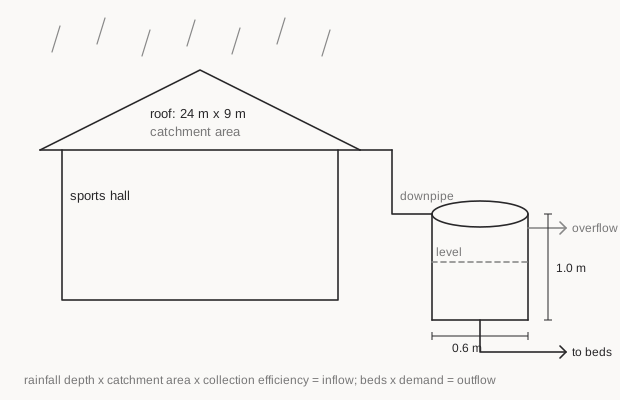
Should the school fit a bigger rainwater tank?
The butt ran dry in the third week of a dry spell and the beds were watered from the mains. How big would it need to be? The capacity is now the unknown, the rate is neither given nor constant, and the length of dry spell to design for is a decision rather than a fact.
A store with an inflow and an outflow. The min is what makes it interesting: the tank overflows in wet weeks, so capacity is not simply the total of the dry-week demand.
Height of a tree → height of the tree
Routine
Angle of elevation 32° from 15 m
Find the height to three significant figures. What is being assessed is whether the solver picks tangent rather than sine, and whether the calculator is in degrees. The tree is a costume.
Modelling task
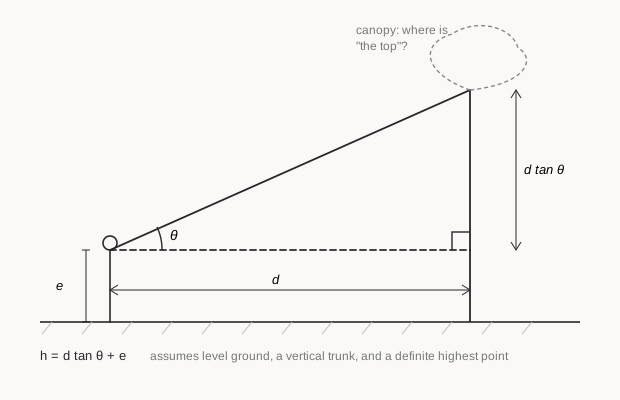
How tall is the tallest tree on the grounds, and how sure are you?
Report a range you are willing to defend, and say which measurement the answer depends on most. Nothing is given. A canopy has no unique highest point, the ground is not level, and asking for a range forces repeated measurement, which makes disagreement visible.
One tangent ratio, in both versions. In the routine problem the diagram is the answer; in the modelling task the same picture is an assumption that has to be argued for.
Average speed → when to leave
Routine
120 km in 1 h 30 min: find the average speed
80 km/h. The word "average" is doing something interesting and the problem does not let it: 80 km/h is equally compatible with a coach that sat still for twenty minutes and one that held exactly 80 the whole way.
Modelling task
What time should the coach leave for the away match?
Kick-off at 14:00, changed and warmed up by 13:30, and a driver who remembers the trip taking "about an hour and a half, but once nearly two". Recommend a departure time and say how likely it is to work, then say what you would change for a cup final.
The whole content is available to a Year 9 class without any probability formalism: an average is not a plan. Planning to the mean is optimal only when being early costs exactly what being late costs, which is almost never the situation.
Maximum area → the fence you actually have
Routine
40 m of fencing, largest rectangular pen
A 10 m square, 100 m². This one does require translation, so it is not quite empty, but the pen is rectangular because the question says so, there is no wall to use, the fencing is a continuous ribbon, and there is no gate.
Modelling task
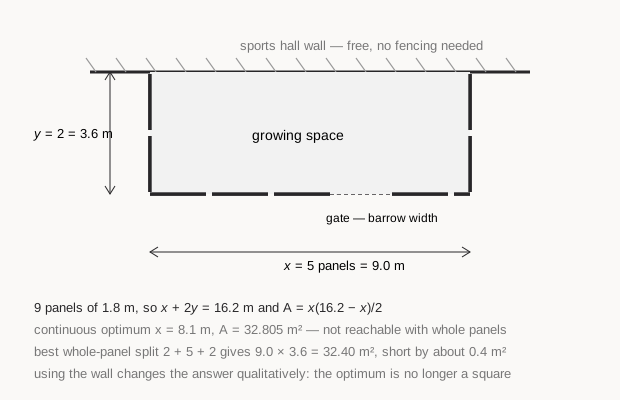
Design the allotment fence with the panels we have
Nine panels of 1.8 m, one side already a solid wall, and a gate wide enough for a wheelbarrow. The optimum stops being a square, the perimeter is quantised, and "usable growing space" is not the same quantity as enclosed area.
The continuous optimum is 8.1 m × 4.05 m for 32.805 m², which cannot be built from whole panels. The best arrangement that can (2 + 5 + 2) reaches 32.40 m², short by about 0.4 m². The useful lesson is not the optimum: it is that the assumption which felt decisive (can panels be cut?) barely mattered, while the one nobody flagged (use the wall) changed everything.
Live · item 17